AI Lead Scoring: A Validation-First B2B Guide
What is validation-first AI lead scoring?
Validation-first AI lead scoring uses a model to propose evidence-linked fit and intent scores, rejects malformed or time-leaking records with deterministic rules, and evaluates the surviving ranking against later outcomes. The score prioritizes human review; it is not treated as a conversion probability or an automatic decision.
TL;DR
- -Define the business outcome, scoring timestamp, and review capacity before choosing a model or inventing score bands
- -Keep ICP fit separate from current intent, and attach source evidence plus an observation time to every non-missing criterion
- -Evaluate on later outcomes with precision at K, recall at K, lift at K, ROC AUC, evidence coverage, and a baseline from the existing process
- -A reproducible synthetic fixture accepts 10 of 16 supplied records and rejects 6 before ranking; its metrics test the evaluator, not a model
- -Use the ranking as decision support, require meaningful human review, minimize personal data, and isolate CRM writes behind least-privilege server-side code
A lead score can look precise while being built on guesses. The model returns 82,
adds a polished explanation, and the CRM moves the record to the front of the queue.
Nothing in that sequence proves the lead is more likely to buy.
The useful question is not “Which LLM should score our leads?” It is:
Can this ranking beat the current process on later outcomes, without using future data or hiding missing evidence?
That question leads to a different architecture. The model proposes a structured score. Deterministic code checks the proposal. A time-based holdout measures the ranking. A person reviews the queue before any consequential action.
The workflow in one diagram
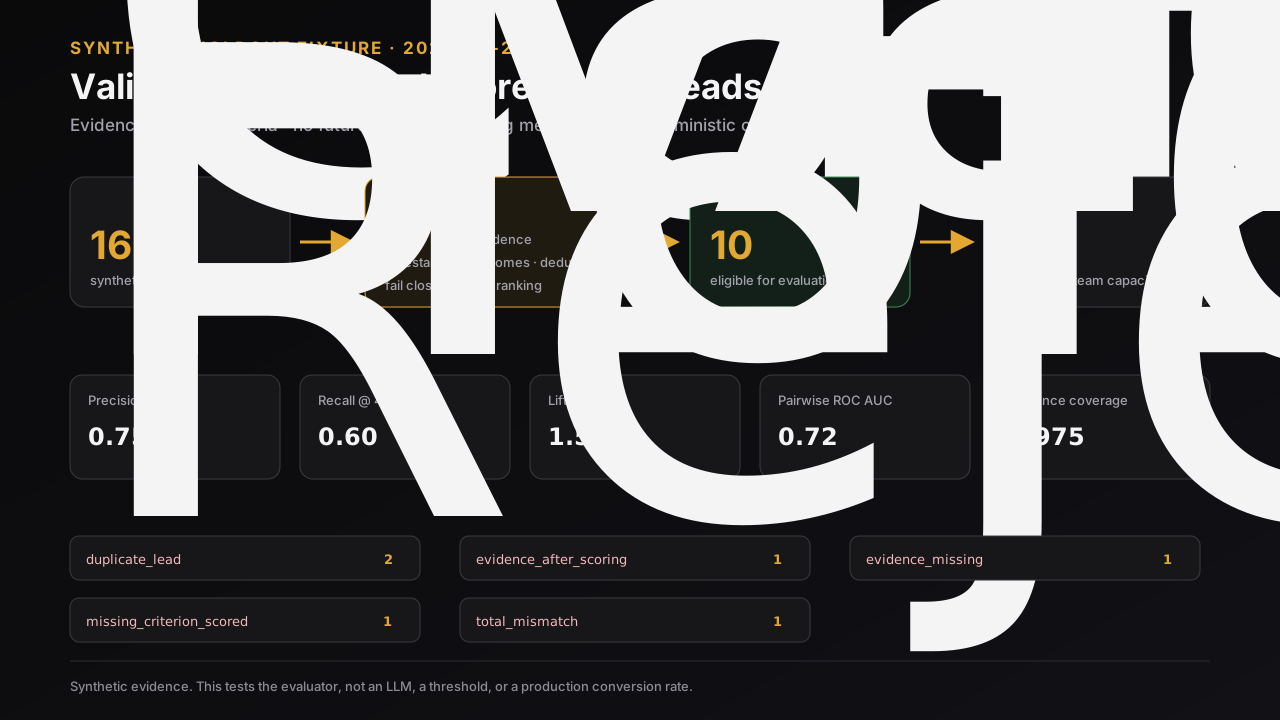
The diagram is generated from a downloadable TypeScript fixture. The fixture contains synthetic records, performs no API calls, and includes 25 automated tests. Its reviewed run supplied 16 candidate scores, accepted 10 for evaluation, and rejected 6 before ranking.
Those numbers prove the validator behaves as documented on the supplied sample. They do not measure an LLM, predict production conversion, or recommend a score threshold.
The production shape is:
sanitized evidence
  → candidate fit and intent scores
  → deterministic validation
  → time-based holdout evaluation
  → human review queue
  → controlled CRM update
Start with the decision, not the prompt
Write down four things before implementing scoring.
1. The outcome
“Converted” is too vague. Pick an event the business already records consistently: qualified opportunity created, paid contract signed, or another stage with a stable definition. Record the outcome timestamp as well as the value.
Do not change the definition halfway through an evaluation. If the sales process changes, start a new score version and document the boundary.
2. The scoring timestamp
Every input needs an observedAt value, and every score needs a scoringAt value.
Only evidence available at or before scoringAt may influence the score. A funding
announcement, reply, product event, or CRM edit that arrived later belongs to the
future, even if it is present in the database when you run the analysis.
This is a common silent failure in retrospective tests: the model appears accurate because the dataset accidentally tells it what happened next.
3. The review capacity
If the team can review 20 new records per day, evaluate the top 20. Do not begin with universal tiers such as “A is 75–100.” The useful cutoff depends on lead volume, seller capacity, response policy, and the cost of a false positive.
Capacity gives K a business meaning. It also makes precision at K and recall at K
directly relevant to the workflow.
4. The baseline
The model is not competing with perfection. It is competing with the current queue: first in, first out; a rule-based score; or a documented human triage process. Save that ordering for the same holdout period. A new system that cannot beat the existing baseline should not control routing.
Separate fit from intent
ICP fit and buying intent answer different questions.
- Fit: Is this account and role within the market the product is designed for?
- Intent: Is there current, observed evidence that this account is evaluating a problem the product addresses?
A strong fit with no current intent may belong in a long-term account plan. Strong intent from a poor fit may need a quick disqualification review. Combining both into one unexplained number removes that distinction.
Define a small rubric for each axis. For example:
| Axis | Criterion | Acceptable evidence | Missing treatment |
|---|---|---|---|
| Fit | company profile | CRM field or approved company source | zero + missing |
| Fit | buyer role | current role in CRM or verified form data | zero + missing |
| Intent | explicit evaluation request | exact form, chat, or email excerpt | zero + missing |
| Intent | timing signal | dated statement or product event | zero + missing |
The table is a contract, not a universal scoring model. Change the criteria and weights to match your ICP, then validate that version against your own outcomes.
Avoid treating a personal email domain, geography, or job title as a blanket negative signal. Those shortcuts can encode acquisition-channel and demographic bias while appearing operationally convenient.
Make evidence part of the output schema
The model should receive the minimum data needed for the rubric and return criteria, not a free-form sales verdict. One candidate can look like this:
{
  "leadId": "lead-042",
  "scoringAt": "2026-08-28T10:00:00Z",
  "fitScore": 31,
  "intentScore": 24,
  "totalScore": 55,
  "fitCriteria": [
    {
      "criterion": "company_profile",
      "score": 19,
      "maxScore": 30,
      "status": "observed",
      "evidenceSignalIds": ["signal-201"]
    }
  ],
  "intentCriteria": [
    {
      "criterion": "timing_signal",
      "score": 0,
      "maxScore": 20,
      "status": "missing",
      "evidenceSignalIds": []
    }
  ]
}
Use an opaque internal ID. Names and email addresses may be unnecessary for the scoring call. Replace raw messages with short, policy-approved excerpts or derived signals when that is sufficient.
If your model provider supports schema-constrained output, use it. OpenAI’s current
Structured Outputs guide
documents json_schema Structured Outputs and recommends it over the older JSON mode
for supported models. Schema compliance only proves that the JSON has the expected
shape. It does not prove that a cited signal exists or that a score is justified.
The extraction instructions should say:
Use only the supplied evidence.
Do not infer missing company size, authority, budget, or timeline.
Mark absent criteria as missing with zero contribution.
Attach evidence IDs to every observed criterion.
Return criteria and scores; do not decide whether sales should contact the person.
Pin the model and rubric versions. Low temperature may reduce variation for some models, but it is not a reproducibility guarantee. Test repeated runs instead of assuming a sampling parameter makes the system deterministic.
Validate before ranking
The public fixture applies fail-closed checks before it calculates any metric:
- Component and total scores stay inside declared ranges.
- Component sums match the total.
- Every observed criterion has a supplied evidence signal.
- The signal belongs to the same lead and the correct score axis.
- Evidence predates scoring, and the outcome follows scoring.
- Missing criteria contribute zero, and duplicate records are rejected.
The synthetic run rejected these records:
| Problem | Reason code |
|---|---|
| cited signal was absent | evidence_missing |
| signal appeared after scoring | evidence_after_scoring |
| declared total did not add up | total_mismatch |
| a missing criterion received points | missing_criterion_scored |
| duplicate lead candidates | duplicate_lead |
Inspect the source, tests, manifest, and exact commands. The code is MIT-licensed. The documentation and generated evidence use CC BY 4.0.
Evaluate the ranking on later outcomes
Use a time split. Build or tune the rubric on older records, then freeze it and score a later period using only evidence available at each scoring timestamp. Wait until the selected outcome has had enough time to mature before reading the result.
For a capacity-limited queue, start with:
- Precision at K: the share of the top K that reached the defined outcome.
- Recall at K: the share of all positive outcomes captured in the top K.
- Lift at K: precision at K divided by the holdout base rate.
- ROC AUC: how often a randomly chosen positive ranks above a negative across the full accepted set.
- Evidence coverage: the share of criteria backed by an observed signal.
- Rejection rate: the share of candidate records that failed validation.
The fixture reports precision@4 of 0.75, recall@4 of 0.60, lift@4 of 1.50, ROC AUC of 0.72, and evidence coverage of 0.975. These are deliberately visible test values from ten accepted synthetic records. They are not targets.
Report counts alongside ratios. A segment with one positive outcome can show an impressive percentage and still tell you very little. Compare performance by source, region, account band, and other operationally relevant segments, but do not publish thin slices that expose individuals.
A ranking score is not a probability
The number 80 does not mean “80% likely to buy” unless the system was explicitly
calibrated and validated as a probability model. Ranking and calibration are separate
tasks.
If the workflow needs probabilities for forecasting, fit a calibration layer on data that was not used to train the underlying score, then inspect reliability by segment and over time. The ICML paper On Calibration of Modern Neural Networks is a useful starting point for the distinction between predictive accuracy and calibrated confidence. Its results are not a guarantee for lead-scoring data.
For sales prioritization, a stable ranking plus capacity-based K is often easier to explain and monitor than a pseudo-probability.
Design meaningful human review
The review screen should show:
- the separate fit and intent scores;
- each criterion, its source, and observation time;
- missing-data warnings and validator reason codes;
- the score, prompt, rubric, and evidence versions;
- approve, reorder, defer, and reject controls;
- an override reason captured as audit data.
Human review must be real. A reviewer who sees only a score and an “accept” button is rubber-stamping automation, not checking it. Keep the original evidence close enough to challenge the result.
Do not use the score as the sole basis for decisions that materially affect a person. EU GDPR Article 22 addresses solely automated decisions with legal or similarly significant effects and includes safeguards such as human intervention in covered cases. Read the current regulation text and obtain jurisdiction-specific advice. Whether Article 22 applies depends on the specific process and its effects. Do not assume that ordinary sales prioritization is either automatically covered or automatically exempt; profiling still requires a lawful, transparent, and proportionate data practice.
Minimize data and isolate side effects
Lead records can contain personal data, private messages, commercial context, and credentials pasted into forms. Before sending anything to a model:
- document the purpose and lawful basis;
- remove fields that do not support the rubric;
- redact secrets and unnecessary identifiers;
- define retention for inputs, outputs, evidence, and audit logs;
- restrict access by role and tenant;
- review provider storage, training, and regional-processing controls;
- give people an appropriate correction or objection path.
OWASP’s guidance on Sensitive Information Disclosure lists PII, commercial data, and credentials among the risks and recommends sanitizing data before model processing. Its guidance on Improper Output Handling also supports treating model output as untrusted input to downstream systems.
The scorer should not hold a broad CRM credential. Put writes in a separate server-side component that accepts only validated fields and uses a least-privilege identity. OWASP’s Excessive Agency guidance recommends minimizing functionality, permissions, and autonomy, with human approval for high-impact actions.
Store reviewable CRM fields
Avoid one mutable ai_score field with no context. Store enough provenance to
reconstruct the decision:
ai_score_total
ai_score_fit
ai_score_intent
ai_score_version
ai_scored_at
ai_evidence_coverage
ai_validation_status
ai_review_status
ai_reviewed_at
Keep compact reason codes or evidence references rather than copying entire private messages into every record. HubSpot’s current CRM properties documentation describes creating and updating custom properties. Other CRMs offer equivalent fields; verify their current API and permission model before implementation.
Make the write idempotent with a key such as leadId + scoreVersion + scoringAt.
Retries should update or return the same scoring record, not create several competing
scores.
Monitor the system after launch
Run the scorer in shadow mode first: calculate scores and collect reviewer feedback, but leave the existing routing in control. Then monitor:
- validation rejection rate by reason;
- missing-data and evidence coverage by source;
- precision, recall, lift, and AUC after outcomes mature;
- reviewer override rate and reasons;
- queue volume and response SLA;
- performance drift by meaningful segment;
- changes in model, prompt, rubric, enrichment, and CRM schemas.
NIST’s AI Risk Management Framework describes testing before deployment and regularly in operation, with documented performance assessment and uncertainty. The AI RMF 1.0 is voluntary guidance, but its measure-and-monitor discipline fits this workflow well.
Implementation checklist
- Define one outcome and its timestamp.
- Freeze a score version and its fit/intent rubric.
- Build a point-in-time evidence set with stable IDs.
- Remove unnecessary personal data before model processing.
- Require structured criteria with evidence references.
- Reject missing, future, duplicate, and inconsistent records in code.
- Evaluate against a time-based holdout and the current baseline.
- Choose K from review capacity, not a copied score band.
- Show evidence and version history to a real reviewer.
- Isolate idempotent CRM writes behind least privilege.
- Run in shadow mode and record overrides.
- Promote only when the evidence supports the change.
An LLM is useful here when important signals live in messy text. If the relevant inputs are already clean fields and events, start with a transparent rule set or a conventional statistical model. The validation, holdout, privacy, and review requirements remain the same.
A lead score is a routing signal, not a verified description of the buyer. Before a sales presentation, use the buyer-specific product demo workflow to separate sourced discovery from assumptions and rehearse only the product state you can actually show.
For the upstream ICP work, see how to define an ideal customer profile. For the approval boundary, see human-in-the-loop patterns.